Tuesday, July 01, 2008

Euro-Credit Crunch

Credit crunch: Central bank likely to raise eurozone interest rates despite downturn

The European Central Bank seems determined to raise interest rates this week, in the hope of reining in soaring inflation across the 13 member countries of the eurozone. But there are warning signs that members are facing a slowdown like the one affecting Britain.

Some countries would be particularly hard hit if the central bank raises its one-size-fits-all interest rate by a quarter point to 4.25% on Thursday - the first rise for a year.

Figures out yesterday made a rate rise all but certain after inflation jumped to a 16-year high of 4% in June, mainly as a result of higher oil prices. The increase was from 3.7% in May and was greater than financial markets had been expecting.

"If there were any remaining doubts about a [0.25 percentage point] rate hike on Thursday, they can now be put to rest," said Martin van Vliet, economist at ING Financial Markets.


Germany, Europe's biggest economy and the world's largest exporter, has been growing very robustly on the back of a sizzling global economy and has shrugged off the strength of the euro, which makes exports less competitive. But other European economies such as Ireland and Spain are in the middle of full-blown housing market meltdown.


The German economy, which grew at 1.5% in the first quarter of this year, now looks in trouble. Rising petrol prices hit consumer sentiment and business confidence has turned down. Unemployment has ticked up for the first time since March 2006 and retail sales have fallen for three months in a row. Some economists think Germany may show no growth at all in the second quarter.


"Until recently the German economy was the last glimmer of hope for the eurozone economy. The powerhouse of the eurozone economy was running strong, fuelling the ECB's famous 'sound economic fundamentals'," said Carsten Brzeski, economist at ING Financial Markets.

"Now, Germany mirrors the malaise of the entire eurozone. Inflation is close to a 15-year high and a whole range of confidence indicators point to difficult times ahead."

Nevertheless, Germany goes into the slowdown with some momentum behind it. Other economies have run out of steam. The once booming Irish economy is in the middle of a housing slump which has brought it to a shuddering halt and raised talk for the first time in many years that people may again start to emigrate.

Housebuilding has plunged by two-thirds this year and employment in construction has dropped sharply. There are anecdotal reports of thousands of Polish builders heading home again.


A similar housing collapse, the result of enormous over-building in recent years and a big drop in demand, is going on in Spain. Spanish unemployment is heading rapidly towards 10% and inflation is above 5%.


France is suffering a slowdown in the housing market, with property sales down 30% this year and prices flagging. The French are panicking about the impact on purchasing power of higher food and petrol prices. Tighter credit conditions generally are undermining economic growth.


Lavinia Santovetti, economist at Lehman Brothers, said: "The euro area retained a good deal of momentum in the first quarter, with GDP expanding by 0.8% quarter-on-quarter. However, there is mounting evidence that the economy is faltering. A sharp fall in growth now looks imminent."

(http://www.guardian.co.uk/business/2008/jul/01/europeanbanks.globaleconomy/print)


aC. Sidebar

I have a simple solution to for our European neighbors and at home regarding the current stock market meltdown, stagflation, and down-hill skiing trend of the US Dollar. ECB (European Central Bank) lower your interest rate. US (Federal Reserve) raise your (our) interest rate.


Why you ask? Didn't the housing bubble start because of higher interest rates? Yes, but times have changed. Our economy, or shall I say our global economy is now concentrated on natural resources (specifically Petro - Euro-talk for petroleum) and ever-more the US dollar. The US dollar is at an all-time low and if the ECB does raise the interest rate for the euro-zone, the US dollar will only fall further.

I'm not an economist, but I have stayed at a Holiday Inn Express and read enough BusinessWeek and non-fiction novels to where I can understand the real issue at hand. The issue at hand isn't the housing market, it's not the gas and dollar stupid.

I believe, under my theory, if the ECB lowers the Euro-zone interest rate, the Euro currency will fall against the dollar, thus propping up the dollar. This will in turn lower the price of crude oil temporary because the dollar is temporary stronger than before. (Don't forget, crude oil is priced in dollars.) Please note, there is a reason for why my theory requires the Federal Reserve to act as well.

Under basic Econ-101, lower interest rates will foster demand, thus stimulating growth. In growth you tread the inflation waters. Sound economics is the balance of supply and demand, on the micro and macro levels. If the ECB were to lower the Euro-zone interest rate, demand will increase for housing and borrowing activities because of the cheaper cost of debt. Counterpoint, risk is significantly higher of inflation because now there exist excess subsequent demand and the ever-so-common point of 'not-enough-supply' to match the demand.

Thus you need the US (Federal Reserve) to raise the (or our) interest rates (both Federal Fund / Overnight Rate). We, as in everyone on Earth, live in an ever-growing economy where Nike Air Force Ones are demand in both the big and small towns of America to the big and small towns of Japan and England. Demand for Caterpiller machinery vehicles and Snap-On tools not only exist here in the states, but the European and Asian states as well. To balance out the sound global economic policy (aC's Global Economic Policy), action must be occur on both sides of the ocean.

Yes, the housing market is sucking right now and people will say raising the interest rates will incur further defaults and bankruptcies. Well, I have news for you. People who enter those stupid loans several years ago or in general who enter bad loans will still default no-matter how much you sugar-coat reality. We've seen how the Federal Reserve has lower consecutively the interest rates from last October to last March to low level that are obscene from the 1980's. I do have to say, rates in the 10% range did wonders for my savings account, but I digress. Even at historically low levels, people are still defaulting on mortgages and the banks are still writing them off to no end.

So, to all the members of the Federal Reserve Policymaking committee (FOMC), listen to your one member that voted against the majority decision during the last meeting. He was right to point out that a more aggressive action (raise not maintain rates) was needed to tame inflation. So it looks I have a Federal Reserve President (Dallas I think) on my side / theory. Raising the interest rates will keep inflation at bay and yes, it will slow demand for borrowing activities and growth, but don't forget the caveat of my theory.

When both sides of the ocean make the appropriate moves that I suggest, the action of each country will incur a positive outcome. For American, the Euro will be cheaper due to a substantial increase in the value of the dollar (due to subsequent ECB and Fed actions). American will travel back to Rome, London, and Paris again. Rick Steve's will continue his travel guide dominance with flair now that the term 'budget' will be back. With a temporary weaker Euro, American can buy more European things (i.e. VW, BMW, and authentic Swedish Bikini Team Calendars) cheaper. Yes, I know that will have an effect on American exports, but that's another discussion on global economics involving guns and butter (sarcastic DePaul Econ humor).

So that' s it. My rant about how the higher US dollar and lower Euro will not only lower crude oil prices, but also balance our economies and we can pretend that it's 1999 all over again, minus Enron and MCI-WorldCom. I'll be waiting for my Nobel Prize in Economics now.



Monday, September 11, 2006

Obesity increasing at alarming rate in Europe

Yahoo!
Mon Sep 11, 10:50 AM ET

Overweight and obesity levels are increasing at an alarming rate within the European Union, with over a quarter of men and a third of women considered obese in some countries, the European Commission has warned.

The EU's executive arm presented the results of a major public consultation on diet and exercise, prompted in part by the 14 million overweight children in Europe of whom over three million are considered obese.

"Up to 27 percent of European men and 38 percent of women (are) now considered to be obese depending on the EU member state concerned," the Commission said in a statement Monday.
The highest prevalence of overweight children is found in southern European countries at around 20-35 percent as opposed to 10-20 percent in northern Europe.

"This is now an urgent public health issue requiring co-ordinated action at EU level, as well as within member states," the Commission said.

According to the consultation's results, it is necessary to increase the availability of healthy foods in canteens or in vending machines, reduce the availability of foods that are high in fat and sugar and to promote sports and other physical activity.

There were also calls for better and clearer consumer information on nutrition.

EU Health and Consumer Protection Commissioner Markos Kyprianou said: "The prevalence of obesity has been rising fast in Europe and there is already evidence that this is leading to increasing rates of conditions such as diabetes and cardiovascular disease."

While respondents from industry favoured self-regulation, healthcare professionals, consumer organisations and NGOs remain sceptical about the impact of self-regulation on advertising of foods high in calories but poor in nutrients.

The commission will consider the policy options "and fine-tune its action with the right balance between voluntary agreements and legislative action", its statement said.

Poor nutrition and insufficient physical activity are among the leading causes of avoidable death in Europe.

Obesity-related illnesses are estimated to account for as much as seven percent of total healthcare costs in the 25-nation bloc.


.aC Sidebar

Three words, the Full-English Breakfest (the Full Monty). Yes, that and the northern England/Scotland tradition of Fried Snickers can't be healthy either. Plus, Octoberfest in Germany, great cheeses of France, and Swiss/Austrian chocolate isn't an ideal methods of diet too.

Friday, July 14, 2006

Give Me a Break!

MSN

What happens when you combine the complex codependent subtext of "Toxic" with the deep and meaningful posterior shout-out that is "PopoZao"? Scarily enough, we could soon find out. Britney Spears, apparently not content just to make chubby-cheeked tots with Kevin Federline, tells Harper's Bazaar (via USA Today) that she's also planning to make music with her would-be rapper hubby.

"I'm so proud of Kevin," the erstwhile pop starlet tells the August issue of the magazine, which features her on the cover sporting chocolate locks, a swelling belly and no clothes. "He's been working so hard on his own album since I got pregnant with Preston. I'm so lucky. He's a doll; he's adorable."

Let's hope that when the scruffy, overly fertile former backup dancer takes a breather from "working so hard," he'll return the compliment to his meal-ticket missus, who could probably use some words of encouragement. The beleaguered Britney, 24, admits that while it's "empowering" to have a bun in the oven, "you don't feel the most beautiful all the time."

She fesses up that she was "paranoid" while pregnant with Sean Preston, 10 months, but says that with "this one, I was like, I've just got to wing it. It was weird for me at first because of who I am. Wherever you go, they expect you to look a certain way. I'm not supposed to be this big huge pregnant superstar."

Spears says she has every intention of returning to form -- and performing -- after her second K. Fed kid arrives in the fall, insisting, "I'm going to get really intense with it."

In other Britney news, did she let her New York condo go for a song? The New York Post reports that after several price reductions, she finally managed to unload her 4,000-square-foot, three-bedroom, four-and-a-half bath, four-level Manhattan penthouse.

The lucky buyer reportedly picked up the palatial pad, once occupied by Keith Richards, for a mere $4 million, far below the nearly $6 million Spears wanted when it was originally listed in July 2004.

The digs, which come complete with a library (barely used, we're sure), terrace, media room and solarium, set Britney back $3 million in 2002.


aC. Sidebar
How can you be proud of a husband that works hard on a non-existent, widely available record that's listenable. Also, how would you feel if your husband is concentrating more on a record than a baby and mother? I don't know how indepth the relationship and quality of communication and maturity, but I would take care of my wife and baby over a stupid album.

I have nothing against Britney, just the fact that I am a viable contender to be a good father, friend, and husband that wooud respect and be very gentlemanly to her drives me nuts. I think the media and world backs me up when we wish to see more out of K-Fed in this relationship. Where was K-Fed when Britney had issues with driving Sean Preston on her lap or when the car seat was in the wrong position. It's not all Britney's fault. K-Fed is a father, heck, he's a father of four counting his ex-girlfriend. This is sad. Having a good weekend Mr and Mrs. Spears.

Give Me a Break!

MSN

What happens when you combine the complex codependent subtext of "Toxic" with the deep and meaningful posterior shout-out that is "PopoZao"? Scarily enough, we could soon find out. Britney Spears, apparently not content just to make chubby-cheeked tots with Kevin Federline, tells Harper's Bazaar (via USA Today) that she's also planning to make music with her would-be rapper hubby.

"I'm so proud of Kevin," the erstwhile pop starlet tells the August issue of the magazine, which features her on the cover sporting chocolate locks, a swelling belly and no clothes. "He's been working so hard on his own album since I got pregnant with Preston. I'm so lucky. He's a doll; he's adorable."

Let's hope that when the scruffy, overly fertile former backup dancer takes a breather from "working so hard," he'll return the compliment to his meal-ticket missus, who could probably use some words of encouragement. The beleaguered Britney, 24, admits that while it's "empowering" to have a bun in the oven, "you don't feel the most beautiful all the time."

She fesses up that she was "paranoid" while pregnant with Sean Preston, 10 months, but says that with "this one, I was like, I've just got to wing it. It was weird for me at first because of who I am. Wherever you go, they expect you to look a certain way. I'm not supposed to be this big huge pregnant superstar."

Spears says she has every intention of returning to form -- and performing -- after her second K. Fed kid arrives in the fall, insisting, "I'm going to get really intense with it."

In other Britney news, did she let her New York condo go for a song? The New York Post reports that after several price reductions, she finally managed to unload her 4,000-square-foot, three-bedroom, four-and-a-half bath, four-level Manhattan penthouse.

The lucky buyer reportedly picked up the palatial pad, once occupied by Keith Richards, for a mere $4 million, far below the nearly $6 million Spears wanted when it was originally listed in July 2004.

The digs, which come complete with a library (barely used, we're sure), terrace, media room and solarium, set Britney back $3 million in 2002.


aC. Sidebar
How can you be proud of a husband that works hard on a non-existent, widely available record that's listenable. Also, how would you feel if your husband is concentrating more on a record than a baby and mother? I don't know how indepth the relationship and quality of communication and maturity, but I would take care of my wife and baby over a stupid album.

I have nothing against Britney, just the fact that I am a viable contender to be a good father, friend, and husband that wooud respect and be very gentlemanly to her drives me nuts. I think the media and world backs me up when we wish to see more out of K-Fed in this relationship. Where was K-Fed when Britney had issues with driving Sean Preston on her lap or when the car seat was in the wrong position. It's not all Britney's fault. K-Fed is a father, heck, he's a father of four counting his ex-girlfriend. This is sad. Having a good weekend Mr and Mrs. Spears.

Tuesday, July 11, 2006

Tuesday, May 09, 2006

FYI Guys...

Darwin Revisited:
Females Don't Always Go for Hottest Mate
May 5, 2006; WSJ.com

At first glance, the "sexy son hypothesis" makes perfect sense. According to this pillar of evolutionary biology, a female who chooses a high-quality male will have sons who inherit dad's allure. They, too, will therefore have their pick of females, allowing mom to hit the jackpot: grandmotherhood.

But when scientists followed male flycatchers whose dads were real catches (as judged by a forehead patch that is this bird's equivalent of perfect abs), they found no such thing.

The sons "did not inherit their father's ... mating status," the Swedish researchers wrote in the February issue of American Naturalist. As a result, mom got fewer grandkids than did females who settled for less-attractive males. The studs were so busy mating they had no time to raise offspring, causing their health and fecundity to suffer. Homelier birds were better dads, raising sons who had more mating success.

Poor Darwin. After he developed his theory of how organisms change through variation and natural selection, his thoughts turned to sex. Because females have few eggs (compared with males' limitless sperm), their best strategy is to select the highest-quality males for mates, he wrote in 1871. That way, their progeny also would have superior traits. The offspring would survive and reproduce better, making mom's fondest wish -- to become a grandmother -- come true. (In evolution, success means reproduction, not only for you but for your descendants unto the nth generation, too.)

The theory of sexual selection -- that females choose males with the best genes, causing those genes to become more prevalent in succeeding generations -- is invoked to explain why peacocks have rococo tails and bucks have huge antlers. Neither trait has real survival value, but females choose males that have them, exerting selective pressure for ever-showier versions.

Or so textbooks say. Just as Darwin's theory of natural selection is under attack by America's religious right, his less-known theory of sexual selection is catching flak from some biologists. "In a number of species, reproductive behavior does not conform to Darwin's theory of sexual selection," says biologist Joan Roughgarden of Stanford University. "The idea that females choose the genetically best males is wrong. Instead of choosing mates who will increase the genetic quality of their offspring, females make choices that will increase their number of offspring."

As in the flycatcher study, mating with "sexy" males isn't necessarily the way to a plethora of descendants. True, in species where males contribute nothing but genes to offspring, this strategy may work. But biologists are finding more and more examples where females benefit from a different strategy.

Female crickets mate with just about any male that asks, for instance. Through promiscuity, not choosing the "best" male, they increase the genetic diversity of their offspring, improving the chances that some will survive no matter what pathogens and enemies the kids encounter.

Other females are not as enamored of sexy traits as theory claims. While big-antlered red deer are busy fighting each other to show a female who has the best rack, the doe sneaks off to mate with less well-endowed stags. Female red-winged blackbirds are not easily impressed, either. Having the most macho plumage has no detectable effect on how many offspring a male sires, David Westneat of the University of Kentucky reported in American Naturalist this week.

Nor is flaunting their charms and competing against other males necessarily the best reproductive strategy, as Darwin thought. In some species, cooperation can bring greater success. Bluegill sunfish, for instance, form trios of one small female, one large territory-holding male and one small male that infiltrate that territory when the female releases her eggs. That lets the little scrawny guy, despite the lack of female-attracting heft, become a dad.

Such strategies, Prof. Roughgarden says, show that "each kind of male has its own way of going about its life. Each works out fine." As she and colleagues wrote in February in Science, "animals cooperate to rear the largest number of offspring possible."

Another problem with sexual selection is that it fails to explain the persistence of, shall we say, homely males. If females choose the male with the best traits, as claimed, then after enough generations every peacock should have a tail to die for. But they do not. Every flock has studs and duds. "Shouldn't all the tails be great?" asks Prof. Roughgarden.

Other scientists are not ready to jettison sexual selection, calling it (as biologist Jerry Coyne did in a review) "powerful and largely correct." But some aren't so sure. Primatologist Sarah Blaffer Hrdy (pronounced "herdy") calls it "ill-advised" to "give precedence to [females'] quests for supposedly the 'best' genes" when they choose a mate.

Mating can indeed be a competitive sport (see: spring break). But many traits that attract females have nothing to do with good genes. For mysterious reasons, females just developed an attraction for them. Men on a quest for perfect abs can take that as fair warning.

Who likes cats?

http://www.snabbstart.com/film/roliga-katter-mycket-roliga.aspx

Monday, March 13, 2006

Current Events Quiz for March

1. Chief Executive Dick Kovacevich received a $7 million bonus for 2005 from which major U.S. bank?

Bank of America

Chase

Citicorp

Wells Fargo


2. What country did Rolling Stone magazine enter for the first time this month with a new edition?

Australia

China

India

Japan


3. AT&T’s planned acquisition of BellSouth comes with a pretty high price tag -- $67 billion, and according to AT&T’s chief financial officer, how many jobs?

None

7,500

10,000

15,000


4. What major airline has decided to take the gloves off and go wing-to-wing with low-cost Southwest Airlines on flights out of Love Field in Dallas?

American

Coninental

Delta

United


5. BlackBerry users are finally letting out a collective breath after Research In Motion Ltd., the maker of the handy little e-mail device, announced Friday it has settled its long-running patent dispute with NTP for $612.5 million. In what state is NTP based?

Connecticut

New Hampshire

Pennsylvania

Virginia


6. Toledo, Ohio-based supplier Dana Corp. filed for bankruptcy protection for its U.S. operations. In what business does Dana operate?

Auto parts

Bakery foods

Electronics

Steel


7. What was the best-selling new product of 2005?

Budweiser Select

Gillette M3Power razors

Slim-Fast’s Optima diet line

Tide with a touch of Downey


8. AK Steel Holding Corp. played hardball with workers after their contract ran out, operating a plant with salaried and replacement workers after locking out nearly 2,700 union employees. Where is the AK plant located?

Ashland, Ky.

Erie, Pa.

Middletown, Ohio

Rockport, Ind.


9. Starbucks has announced it will start buying coffee for its Blue Bourbon brand from which central African country?

Central African Republic

Chad

Rwanda

Zambia


10. What company recently announced it will spend $300 million to build a new plant in Vietnam?

GM

Intel

Kimberly-Clark

Nestlé

http://www.msnbc.msn.com/id/11099319/

Tuesday, March 07, 2006

Why Reality TV shows sucks...

The Bachelor' Couple Say Romance Is Over

Humphrey Bogart said it to Ingrid Bergman in "Casablanca" and now Dr. Travis Stork can say it to Sarah Stone: "We'll always have Paris."

Stork, an emergency room physician, chose Stone, an elementary school teacher, in the finale of ABC's "The Bachelor: Paris" last week.

The couple told The Tennessean in a joint interview Monday they are no longer a couple.
Stork, 33, said the rules that prohibited them from dating or being together in public between the end of the show's taping in November and the Feb. 27 finale were hard on their relationship.
The France-set "Bachelor" deployed 25 women to vie for Stork's affections during a series of glamorous dates. The season began in January.

"You're in Paris and you're part of this incredible experience, this fantasy world, and then suddenly you come back to Nashville, and living in the same city I think we thought was going to be a great thing," he said. "But instead, you're forced to pretend you don't know someone, for essentially the last four months.

"The reality is that we were in this fantasy world. And now that we're back in Nashville, over time when you're not allowed to see someone, you grow apart."

Stone, 26, said, "I definitely think it would've worked out differently" if she and Stork had met and dated under different circumstances.

"We wouldn't have had all the baggage that comes from being on this show. It would just be the two of us being able to hang out and get to know each other in a normal situation," she said.

Both said they remain single and unattached and that they had no regrets about doing the show.
"Through this time, we realized that it was a great experience in Paris and that we're so lucky to have met one another in Paris, and we'll never forget that," Stone said. "And we both agree and know that we'll be friends forever."

Asked if they might reconnect romantically after publicity has died down, both just laughed.

Friday, March 03, 2006

March Madness

March Madness...64 teams...64 colleges...greatest time of the year!

Friday, February 24, 2006

Comic of the Week


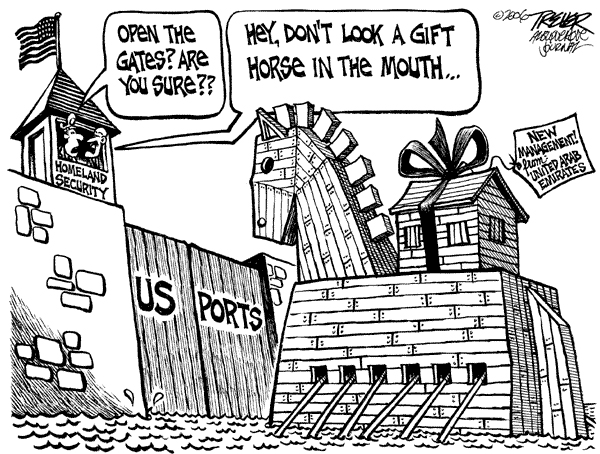
It is safe to say that a) US are scared of Arab people or b) Americans are better authorites at the ports than Arab people.

Friday, February 03, 2006

Give me a break...again...

'Faust' Opera Video Stirs Angry Parents
Yahoo

Some parents in this prairie town are angry with an elementary school music teacher for showing pupils a video about the opera "Faust," whose title character sells his soul to the devil in exchange for being young again.

"Any adult with common sense would not think that video was appropriate for a young person to see. I'm not sure it's appropriate for a high school student," Robby Warner said after two of her children saw the video.

Another parent, Casey Goodwin, said, "I think it glorifies Satan in some way."

Tresa Waggoner showed approximately 250 first-, second- and third-graders at Bennett Elementary portions of a 33-year-old series titled "Who's Afraid of Opera" a few weeks ago.
The video features the soprano Dame Joan Sutherland and three puppet friends discussing Gounod's "Faust." Waggoner thought it would be a good introduction to opera.

Her critics questioned the decision to show children a portrayal of the devil, Mephistopheles, along with a scene showing a man being killed by a sword and a reference to suicide.
School Superintendent George Sauter said the teacher should not have shown the video to children below the fourth grade but will not lose her job. She has sent letter of apology to all elementary school parents in Bennett, population 2,400 and about 25 miles east of Denver on Colorado's eastern plains.

"I was definitely not sensitive to the conservative nature of the community, and I've learned that," Waggoner said in Sunday's editions of The Denver Post. "However, from what has been said about me, that I'm a Satan worshipper, my character, I can't believe all of this. My intention was just to expose the kids to opera."

Waggoner, who is in her first year teaching vocal music in Bennett, said she doesn't expect to stay in town.

"I know I'm not accepted here, that I'm not welcome here by the parents," she said. "It's a very uncomfortable position."


aC. Sidebar

You know Faust is a 18th century opera/drama. It is considered to be a classical masterpiece. It's comparable to Aesop's fable teaching the consequences of pride and vanity. Now think, about this, we will show Shakespeare with his romancing Juliet and sword-welding Hamlet in our schools, but when "the devil" comes around we all hide and protect our childen. So some reason, the conservatives worship the idea of banishing the devil, but won't allow moral acts of literature and arts show them from temptations.

No, I won't testify, but I will say that adults are getting stupider. I'm not saying that all adults are morally, parently, and common-sensely challenged, but more like they don't think. Please, give me a break. How many people, let alone students have ever heard or know what Faust is about. We as people will allow the play of Grand Theft Auto to children, but when the arts have a moral lesson we run away. This is truely a shame for mankind. Not to you, but the privilage that these students have lost to neo-conservatism in the great state of Colorado. Hmm...I wonder what Kobe is up to these days?

Friday, January 20, 2006

Privacy

Google Rebuffs Feds on Search Requests

AP Business

Google Inc. is rebuffing the Bush administration's demand for a peek at what millions of people have been looking up on the Internet's leading search engine — a request that underscores the potential for online databases to become tools for government surveillance.

Mountain View-based Google has refused to comply with a White House subpoena first issued last summer, prompting U.S. Attorney General Alberto Gonzales this week to ask a federal judge in San Jose for an order to hand over the requested records.

The government wants a list all requests entered into Google's search engine during an unspecified single week — a breakdown that could conceivably span tens of millions of queries. In addition, it seeks 1 million randomly selected Web addresses from various Google databases.
In court papers that the San Jose Mercury News reported on after seeing them Wednesday, the Bush administration depicts the information as vital in its effort to restore online child protection laws that have been struck down by the U.S. Supreme Court.

Yahoo Inc. (Nasdaq:YHOO - news) and Microsoft Corp., which operate the next most-used search engines behind Google, confirmed that they had complied with similar government subpoenas. America Online said it didn't fully comply with the subpoena but did provide a list of search requests already publicly available from other sources.

Combined, Google, Yahoo, Microsoft's MSN and AOL handle nearly 90 percent of all U.S. search requests, according to Nielsen/NetRatings.

Although the government says it isn't seeking any data that ties personal information to search requests, the subpoenas still raise serious privacy concerns, experts said. Those worries have been magnified by recent revelations that the White House authorized eavesdropping on civilian communications after the Sept. 11 attacks without obtaining court approval.

"Search engines now play such an important part in our daily lives that many people probably contact Google more often than they do their own mother," said Thomas Burke, a San Francisco attorney who has handled several prominent cases involving privacy issues.

"Just as most people would be upset if the government wanted to know how much you called your mother and what you talked about, they should be upset about this, too."

The content of search request sometimes contain information about the person making the query.

For instance, it's not unusual for search requests to include names, medical profiles or Social Security information, said Pam Dixon, executive director for the World Privacy Forum.

"This is exactly the kind of thing we have been worrying about with search engines for some time," Dixon said. "Google should be commended for fighting this."

Sunnyvale, Calif.-based Yahoo stressed that it didn't reveal any personal information. "We are rigorous defenders of our users' privacy," Yahoo spokeswoman Mary Osako said. "In our opinion, this is not a privacy issue."

MSN said it complied with the government's request "in a way that ensured we also protected the privacy of our customers."

As the Internet's dominant search engine, Google has built up a valuable storehouse of information that "makes it a very attractive target for law enforcement," said Chris Hoofnagle, senior counsel for the Electronic Privacy Information Center.

The Department of Justice argues that Google's cooperation is essential in its effort to simulate how people navigate the Web.

In a separate case in Pennsylvania, the Bush administration is trying to prove that Internet filters don't do an adequate job of preventing children from accessing online pornography and other objectionable destinations.

Obtaining the subpoenaed information from Google "would assist the government in its efforts to understand the behavior of current Web users, (and) to estimate how often Web users encounter harmful-to-minors material in the course of their searches," the Justice Department wrote in a brief filed Wednesday

Google — whose motto when it went public in 2004 was "do no evil" — contends that submitting to the subpoena would represent a betrayal to its users, even if all personal information is stripped from the search terms sought by the government.

"Google's acceding to the request would suggest that it is willing to reveal information about those who use its services. This is not a perception that Google can accept," company attorney Ashok Ramani wrote in a letter included in the government's filing.

Complying with the subpoena also wound threaten to expose some of Google's "crown-jewel trade secrets," Ramani wrote. Google is particularly concerned that the information could be used to deduce the size of its index and how many computers it uses to crunch the requests.
"This information would be highly valuable to competitors or miscreants seeking to harm Google's business," Ramani wrote.

Dixon is hoping Google's battle with the government reminds people to be careful how they interact with search engines.

"When you are looking at that blank search box, you should remember that what you fill can come back to haunt you unless you take precautions," she said.


aC. Sidebar

I'm a big proponent for privacy, because heck, don't we all want privacy. It's not written in the Constitution, but privacy can be inferred as a liberty, a right, or a destination from the pursuit of happiness. So where do you draw the line on privacy? How can we as people and upright vocalists for freedom demand privacy when we're so consumed with the daily tabloids, reality television, and restraining murders, sex offenders, and proliferators of child pornography.

So my question is, where do you draw the draw the line of conservatism and libertarianism, but much more of common sense? We know what we want and we will make decision for ourselves and erroneously for others as well. We err in understand proper judgment and decision process. So in another words, don't be offended to be called a hypocrite when you're trying to live the Walden life but your civil disobedience tunes you into Big Brother 25 or if your younger, Laguna Beach. Everyone should be allowed a proper amount of privacy and if one chooses to compromise their privacy for their 15 minutes of fame or a felonies or two, then they shouldn't be surprised to lose their privacy.

I know a lot of us aren't felonies and belong to good wholesome families and upbringings, so I can understand the fear and the need to be able to live privately, but as a species, we aren't wholesome. We want ADT security and cameras to protect the boogie-man. So why compromise 100% privacy. This is what I don't understand and want to know why we say one thing, but sort of mean something else.

Now back to Google. They are the world's largest search engine. I know when I type in a person's name; I can find a lot of information. In fact, I can find sources that will find your social security card information and address for a nominal fee. If you're graphic bound, you can even find nude pictures of Nicole Kidman, but wait. Don't you have to be 18 or so of age to view adult pictures? So why do adult sites force an additional age verification page while search on Google by-passes this page. The Google technology if you aren't aware is not just searching keywords of the billions of websites, but caching the image and text from these sites so that Google will have a fast and accurate library to search from. This is very effective.

So if your running a child pornography ring between El Paso, Texas and Amarillo, Texas, no one in Alaska may be looking for it, but they may run into it. Now, there are security systems in place with Google, so there such far-end results are mitigated, but Google is a tremendous tool for everyone (user) that any electronic investigation or need to police would have included the help of Google. In my opinion, Google has to release these records. In other words, this library will have to transfer evidence of users that has checkout or read materials that are deemed in appropriate, for the better good of the community.

I know, you're like what? Are you still a 9/11 fanatic with a sheriff mentality to police with complete disregard? No. I'm not that phobic, but this is an example of a situation that would lend itself as something that is for the better good of society. Don't you want the sex offenders in jail? Don't you want criminals in jail?

Even if the police would look though your records or files, if your clean, your clean. If you're wearing grandma's gown and your teeth are sharp, with oh so big eyes, then you're screwed and the authorities have done their job. Protection, minus privacy. So how much can you take from this tradeoff??

Tuesday, January 10, 2006

Comic of the Week


aC. Sidebar

Our grandparents and even our parents are screwed...but not as bad as us when we're 50. Sorry to be a pessimist.

Thursday, January 05, 2006

Happy New Year!!!

To the National Champs! Texas Longhorns!!!

This will be a great year, because not only did Texas pull off an upset, but so did my home-team West Virginia Mountaineers, and JoePa's Penn State. This week, is truely the best week of college sports, next to March Madness.

Tuesday, December 20, 2005

RE: Thank You Senators

In retrospect to a recent blog I read, I thought long and hard about the Patriot Act that was recently defeated in the Senate Halls. I thought long and hard about the underlying dilemma of the Patriot Act. Are Americans scared shit-less or are we all (us fellow Americans) crazy, introverted homebodies that would be considered sleeping giants that would not want to meddle with affairs outside the comforts of the living room?

I have often presumed that American and the Chinese are very much a like. Besides, us Chinese (Americans) aren't even considered a minority group anymore. I mean, we practically make up the majority in the Top 50 university and technological programs in the nation. Joking, aside, the Chinese were very isolationist people that shun western society until Great Britain and Portugal came in confiscated land during the Opium War and forced the Far Eastern society to not be so private anymore. In the other hemisphere, the Monroe Doctrine strived Americans to be they're own masters of their domains without interference of European influence (Namely Napoleon) Together, with destiny of the Manifest Destiny, us American grew to be expansionistic pigs. Well, the topic about McDonalds and obesity is another blog subject.

So now how are we as American respond to privacy issues? Don't forget, we're greedy pigs that shun other society out. We don't want black-boxes in our cars, we don't want pop-ups and telemarketing, and we certainly don't want big brother to check out neighbor or homes, regardless if it's part of Neighborhood Watch. So we also shun the Patriotic Act.

Personally by all means I'm opposed to the Patriotic Act, namely because I do not have the legal capacity to pick-it over with a fine-tooth comb. I understand that some practices may seem out of hand, absurd, and even like a strip-search without the cold, latex hands. I wish I had more time to read about the actual legislation turn to simple notes and paper of history, and to give more of an honest response, but the purpose of my blog today is to find out how private are we and defendable are we for our right to privacy, are afraid of the Patriot Act.

I should mention, I have read nothing but attacking articles, except for one pro-sided piece about the Patriot Act, so some misnomers and one-sided thinking is present. So, what's Jessica Simpson up to these days? Serious, we all want to know about the divorce. Who’s going to get the alimony? How about Kate and Tom, or even Bennifer?

Now how about the tragedy of Princess Diana. Now, that's privacy gone deadly. Then how about reality television? Real World Chicago, Big Brother 10, Survivor Jumanji-Style. Granted reality television is fake, but still we private Americans that shun telemarketers by storming the Do Not Call directory want our 15 minutes of fame. Now how about this, we want privacy and piece at weddings and funerals, but we announce the terms and story in the newspaper and OB. We also have webcam action for a cost of $14.95 a month for those over 18. We sign up for Martins, Safeway, Giant, and Dominick's grocery cards and other frequent diner, buyer, or seller cards with our personal information away. We use our Social Security numbers in public like a locker combination to apply for credit and more credit. The blog about debt-bleeding Americans will come soon.

So do we want to know where rapists, murders, and felons are in the neighborhood are? Yes, so screw their privacy. We want to know how our children are doing in school. Sure, until they go to college where their failures are kept from you. (HINT: Going to school for 7 years does not mean you're a doctor of gen. Ed) We want to build in new developments that will be more affordable and pleasant because they're closer to nature. So, screw you "Natural Habitat" and "Bambi"! Oh, have I mentioned that celebrities are screwed too?

So what is the comfort level for privacy? I'm willing to put an automotive black box in my car if it means lower insurance premiums. I'm willing to get a Banana Republic card if I annually get a $25 off card. I'm willing to have my library card history, purchase, and credit history check to make sure that this .aC (because my name is like the Chinese version of John Smith) isn't the one whose plotting the next terrorist attack, to killing someone, to building a bomb, or the rapist next door. Ever seen those Citibank ads about identify theft, privacy is not private anymore. What is it in it for me? To me, a Patriot Act with a value proposition will fly with me. What about you?

Monday, December 12, 2005

Barnes and Noble

GET YOUR TEXTBOOKS HERE!!!

Barnes & Noble.com Home Page


aC. Sidebar
In my history of cheapness and thrift, B&N has been my primary source of textbooks at DePaul and Northwestern. College bookstores are definately over priced, but B&N offers very competitive rates. Plus, I'm a B&N member, so I can get you an additional 10% if you want.

Wednesday, December 07, 2005

Crazy Deers

Five Deer Leap to Deaths From W.Va. Garage
Tue Dec 6

Either they misjudged the distance or they couldn't take the traffic. For reasons that mystify authorities, five deer that made their way onto the top of a five-story parking garage suddenly leaped to their deaths Sunday.
Police Cpl. Steve Cox found the does' bodies on a service road to the Charles Town Races & Slots, next to a security van they'd narrowly missed.

"They took the plunge," he said. "It was just absolutely weird."

A woman called police when she saw the deer falling, and Cox said he found scratches and animal hair on the fifth floor, indicating that's where they had been.

It's unclear how the deer got into the garage, but Cox said they may have become frightened after getting trapped. Cars moving through the garage may have spooked them, he said.

Or they could have been fooled by trees that can be seen from the top of the garage, mistakenly thinking they were close to home.

The carcasses were given to passers-by for butchering.


aC. Sidebar
The interesting thing about this story is the pleasantry of deer meat. At least it's not road kill, or should I say, self-inflicted plunge. I wondering if deer taste like chicken?

Monday, November 21, 2005

Comic of the Week


aC. Sidebar

Make sure your son or daughter isn't bring home to his or her's room:

a) His or Her 40-yld gym or language arts teacher
b) Psycho 18-yld with 50 guns at home, who plays Grand Theft Auto and like trench coats
c) Barbie or Miss Teen of Little Town of Paw-Paw type that's superfacial and has a face of a ghost
d) His or Her's First, Second, or equivalent cousin or other family members
e) Pee-Wee Herman or R. Kelly

Wednesday, November 16, 2005

Math Formula of the Week

Bayes' theorem

Simply put, Bayes’ theorem gives the probability of a random event A occurring given that we know a related event B occurred. This probability is noted P(AB), and is read "probability of A given B". This measure is sometimes called the "posterior", since it is computed after all other information on A and B is known.

According to Bayes’ theorem, the probability of A occurring given B will be dependent on three things:The probability of A occurring on its own, regardless of B. This is noted P(A) and read "probability of A". This measure is sometimes called the "prior", meaning it precedes any other information – as opposed to the posterior, defined above, which is computed after all other information is known.

The probability of B occurring on its own, regardless of A. This is noted P(B) and read "probability of B". This measure is sometimes called the normalising constant, since it will always be the same, regardless of which event A one is studying.

The probability of B occurring given that A occurred. This is noted P(BA) and is read "probability of B given A". This measure is sometimes called the likelihood, since it is the likelihood of A occurring given that B occurred. It is important not to confuse the likelihood of A given B and the probability of A given B. Even though both notions may seem similar and are related, they are quite different.

Example

To illustrate, suppose there are two bowls full of cookies. Bowl #1 has 10 chocolate chip cookies and 30 plain cookies, while bowl #2 has 20 of each. Our friend Fred picks a bowl at random, and then picks a cookie at random. We may assume there is no reason to believe Fred treats one bowl differently from another, likewise for the cookies. The cookie turns out to be a plain one. How probable is it that Fred picked it out of bowl #1?

Intuitively, it seems clear that the answer should be more than a half, since there are more plain cookies in bowl #1. The precise answer is given by Bayes' theorem. But first, we can clarify the situation by rephrasing the question to "what’s the probability that Fred picked bowl #1, given that he has a plain cookie?” Thus, to relate to our previous explanation, the event A is that Fred picked bowl #1, and the event B is that Fred picked a plain cookie. To compute Pr(AB), we first need to know:

Pr(A), or the probability that Fred picked bowl #1 regardless of any other information. Since Fred is treating both bowls equally, it is 0.5.

P(B), or the probability of getting a plain cookie regardless of any information on the bowls. In other words, this is the probability of getting a plain cookie from each of the bowls. It is computed as the sum of the probability of getting a plain cookie from a bowl multiplied by the probability of selecting this bowl. We know from the problem statement that the probability of getting a plain cookie from bowl #1 is 0.75, and the probability of getting one from bowl #2 is 0.5, and since Fred is treating both bowls equally the probability of selecting any one of them is 0.5. Thus, the probability of getting a plain cookie overall is 0.75×0.5 + 0.5×0.5 = 0.625.

Pr(BA), or the probability of getting a plain cookie given that Fred has selected bowl #1. From the problem statement, we know this is 0.75, since 30 out of 40 cookies in bowl #1 are plain. Given all this information, we can compute the probability of Fred having selected bowl #1 given that he got a plain cookie, as such.

As we expected, it is more than half. ((.75 * .5) / .625)